
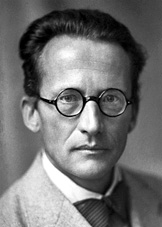
Erwin Schrödinger was an Austrian physicist who is known for his contribution to quantum mechanics. The quantum revolution began in the early 20th century, with physics giants like Max Planck, Albert Einstein, Ernest Rutherford, Neils Bohr, Louis de Broglie and Wolfgang Pauli coming together to develop an entirely new description of the physical world.
Schrödinger’s breakthrough was in realizing that matter, like light, could be described as both a particle and a wave. The Schrödinger equation is a partial differential equation that accurately predicts the values that we observe for quantum mechanical behaviour. More technically, it describes how the wave function of a physical system evolves over time. In one dimension,

It was Schrödinger who offered the first physical interpretation of the equation, when he identified the wave function as the electron charge density. It has since been reinterpreted many times. Max Born interpreted it as an electron’s probability density. Niels Bohr and Werner Heisenberg devised the Copenhagen interpretation that says quantum mechanics can only predict the probability of measuring a given value. Physical systems have no definite state – they exist in all possible states until you make a measurement. The action of taking a measurement causes the system to “collapse” into one of it’s many possible values.
Many people find the Copenhagen interpretation to be unintuitive and nonsensical. Schrödinger was one of them.
You may have heard of Schrödinger’s cat. This is his famous thought experiment he devised to illustrate the paradox that the Copenhagen interpretation presents: a particle exists in all possible states until it is observed. So he imagined a cat in a box with a radioactive material, a Geiger counter, and a bottle of poison. If the material decays, it sets off the Geiger counter and the bottle of poison is broken, killing the cat. According to the Copenhagen interpretation, the material both has and has not decayed (the cat is both dead and alive) until an observation is made inside the box!
Erwin Schrödinger was awarded the Nobel Prize in Physics in 1933 along with Paul Dirac for their discovery of new and productive forms of atomic theory.
Fun fact: There is a street at CERN named after him!
 Melissa Valdez, MSc