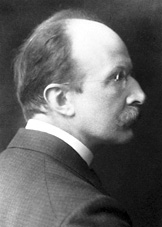

Max Planck was a German physicist who is credited with finding the relationship between the energy and the frequency of electromagnetic radiation. His equation sparked the quantum revolution that took place at the beginning of the 20th century. The famous equation relates the energy E, of a wave to it’s frequency, 

The constant 


Another important contribution made by Max Planck was his work on thermal radiation. Planck’s Law describes the electromagnetic radiation of a black body (one that absorbs all incident radiation). This equation, and its derivation, allowed Planck to hypothesize that only discrete amounts of energy exist – an idea that Albert Einstein took very seriously. Einstein was able to explain the photoelectric effect by proposing that light comes in little packets called “quanta”, with energy given by Planck’s relationship. We call those little packets of electromagnetic radiation “photons.”
Planck was awarded the Nobel Prize in physics in 1918 for his advancement of physics by his discovery of energy quanta. There are several Max Planck Institutes around the world all specializing in extraordinary research endeavours.
Fun fact: The asteroid 1069 was named after him as “Stella Planckia” by the International Astronomical Union in 1938.
 Melissa Valdez, MSc