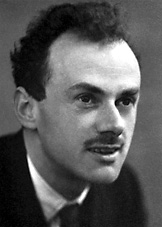

Paul Adrien Maurice Dirac was born in 1902 in Bristol, United Kingdom. He is credited with formulating a fully relativistic quantum theory, and won the Nobel Prize in Physics for his work in 1933, along with Erwin Schrödinger for the discovery of new productive forms of atomic theory.
Dirac’s relativistic wave equation (in natural units),

explains how the very small and fast, like electrons, behave in the quantum world. His interpretation of the solutions to this equation led to the first theoretically predicted particle, before it was observed experimentally. He predicted a particle that behaved exactly like an electron, but that had positive charge – a positron, the antiparticle of the electron. Eventually he expanded his interpretation to include all types of sub-atomic particles, stating that they all had counterparts that shared all of the same properties except with opposite electric charge. Then, just as protons, neutrons and electrons combine to form atoms, antiatoms are formed by the combination of antiprotons, antineutrons and positrons. The positron was observed by Carl Anderson in 1932, four years after it was predicted by Dirac.
Paul Dirac is one of my Science Heroes because my graduate research is fundamentally an experimental continuation of his work. We in the ALPHA collaboration study the properties of anti-hydrogen, the simplest anti-atom. Measuring identical values for the properties of anti-hydrogen as we’ve measured for regular hydrogen would constitute evidence for Dirac’s formalism of relativistic quantum mechanics. Measuring something different would be a big surprise, and would challenge the entirety of quantum field theory.
In June 2014, the ALPHA collaboration published a paper reporting the measurement of the electric charge of antihydrogen to be zero, to within 8 decimal places. The electrical charge of regular hydrogen is of course zero, because atoms are neutral. (An atom always has an equal number of electrons and protons, so the net electric charge is zero.) So far, all of our observations match Dirac’s predictions. Moving forward, we work to measure more properties in even greater detail.
Fun fact: Paul Dirac was an introverted individual who, when told by Werner Heisenberg that it was a pleasure to dance with nice girls, replied, “How do you know beforehand that the girls are nice?”
 Melissa Valdez, MSc
One response to “Science Hero: Paul Dirac”
I love reading the things you write. As usual, you never cease to amaze me. Keep up the good work!