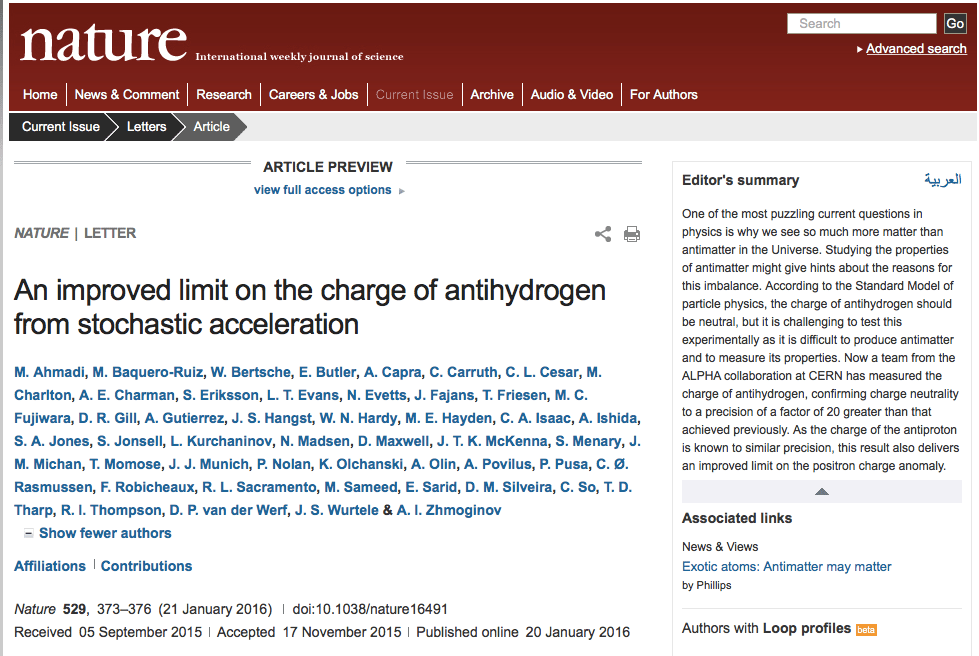
Today the collaboration I work with for my Master’s research at York University had a paper published in Nature! My supervisor, Scott Menary, and his recent PhD graduate student, Andrea Capra, are quoted talking about the experiment in this York University article. Andrea’s PhD thesis has a lot to do with the topic of the paper. Technically it’s reporting on improving the measurement of the charge of an antihydrogen atom using randomly determined (stochastic) acceleration. I can almost hear my grandma saying “in English this time?!” so here’s my explanation about why this is such a cool experiment.
The asymmetry problem
ALPHA’s experiments are designed to study the asymmetry problem, the apparent difference in the amount of matter and antimatter in the observable universe. In theory, both should have been produced in equal amounts after the Big Bang, and then should have instantly annihilated with each other – but obviously that didn’t happen (we are made of matter, and are here to talk about it)! Physicists want to know where all the antimatter went. As Andrea says in the York Univerisy article, we are looking for differences between matter and antimatter that may explain why we live in a matter-dominated universe.
ALPHA-2 is the experiment that improved the measured value of the charge of antihydrogen (the paper published today). It’s also the experiment being used to observe the energy spectrum we see when we point lasers at antihydrogen atoms, a process called spectroscopy. My master’s project will involve helping to build simulations (and possibly the prototype!) of a new experiment called ALPHA-g, which will measure antihydrogen’s acceleration due to gravity. All three of these things: charge, energy spectrum, and gravitational acceleration, have values which are well-known for regular hydrogen. By comparing the values we measure for antimatter to those known for regular matter, we can find differences that might help us answer our question.
The charge of antihydrogen
So what is the measured charge of antihydrogen? Zero, of course! All atoms have an equal number of negative electrons and positive protons – making their net charge zero. We say they are neutral. Or in the case of the Nature paper, we say that ALPHA has measured zero…
“…confirming charge neutrality to a precision of a factor of 20 greater than that achieved previously.”
Over the summer I got to work on ALPHA-2, and was present at some of the meetings where this paper was being put together. (It was an awesome experience!) This is a very exciting day for all those involved in ALPHA, but I’d like to offer a special congratuations to my colleague Andrea for his success following his doctoral research!
Update 01/21/16: check out this Globe and Mail article, “Antimatter experiment probes for cracks in Nature’s Mirror” by Ivan Semeniuk. It’s awesome!
Update 01/22/16: an article from CERN!
Update 01/29/16: This Physics World article contains an awesome video of Professor Jeff Hangst, with more commentary from my supervisor, Professor Scott Menary and his recent PhD grad, Dr. Andrea Capra.
 Melissa Valdez, MSc