This article brings together a series of LinkedIn and Twitter posts published over the course of a week.
Like most physicists, I’ve always ‘nerded out’ over new technology, but quantum computing is particularly exciting to me. Quantum computers are not simply more powerful classical computers. They constitute a fundamentally different computing paradigm.
Instead of two possible states per bit (0 and 1), each qubit (quantum bit) has dozens of states it can be in at the same time. This is a quantum property called superposition, and if you’re weirded out by this concept, you’re in good company.
Mathematics has helped us grapple with the quantum weirdness, and after several decades of research activity, physicists around the world have started building the first generation of quantum computers.
This week I want to talk more about why quantum computing is so neat, including the types of quantum computers delivering promising results and some exciting applications that industry leaders are already integrating into their businesses.
Types of Quantum Computers
There are two types of quantum computers you may have heard about:
- Quantum annealers
- Gate-based quantum computers
Quantum annealers work by encoding the problem you’re trying to solve in the qubits (quantum bits) and then evolving to the system’s lowest energy state. Quantum annealers are great at solving classical optimization problems, an extremely common and immediately applicable use case for business. In 2011, D-Wave’s quantum annealer became the first commercially available quantum computer. Since then, their customers have built over 250 use cases across many industries and are seeing real returns on investment. Today’s quantum annealers have 1000s of qubits.
Gate-based quantum computers are ‘universal’ in that they process any algorithm that can be expressed as a series of logic gates. Dozens of companies are building gate-based quantum computers using all kinds of qubit modalities, including: superconducting circuit qubits, trapped ion qubits, and photons. The ‘holy grail’ is often defined as a 1 million-qubit universal fault-tolerant quantum computer. Today, gate-based quantum computers can run simple quantum algorithms with their 10s or 100s of qubits, and even these “small and noisy” quantum computers are being applied to important business problems with impressive results.
Quantum Advantage
Not every algorithm will exhibit a quantum speedup, but there are many that will.
Quantum algorithm speedups have been proven in a few areas:
1. Quantum chemistry. The simulation of quantum systems is the home field advantage for quantum computers. They are exponentially better at handling the large number of variables required to accurately model a quantum system. This speedup has exciting implications for medicine, materials science, and the environment.
2. Factoring. Shor’s algorithm offers an exponential speedup in the effort to find the prime factors of an integer. The difficulty that classical computers have performing this task is the basis of RSA encryption and much of today’s internet security.
3. Linear systems. The HHL algorithm samples solutions to systems of linear equations. It has been shown to have a polynomial speedup over the best classical algorithms. This has significant implications for the field of machine learning.
4. Search. Grover’s algorithm has a proven polynomial speedup over the best classical search algorithms. This speedup has implications for unstructured search and can be used to solve a variety of problems, including optimization problems.
There are many important problems without fast classical algorithms available. As the field of quantum computing continues to grow you can expect more applications for algorithms that demonstrate quantum advantage.
Hybrid Quantum Computing
Are quantum computers going to make classical computers obsolete?
It’s a great question, and the answer is…
Not likely.
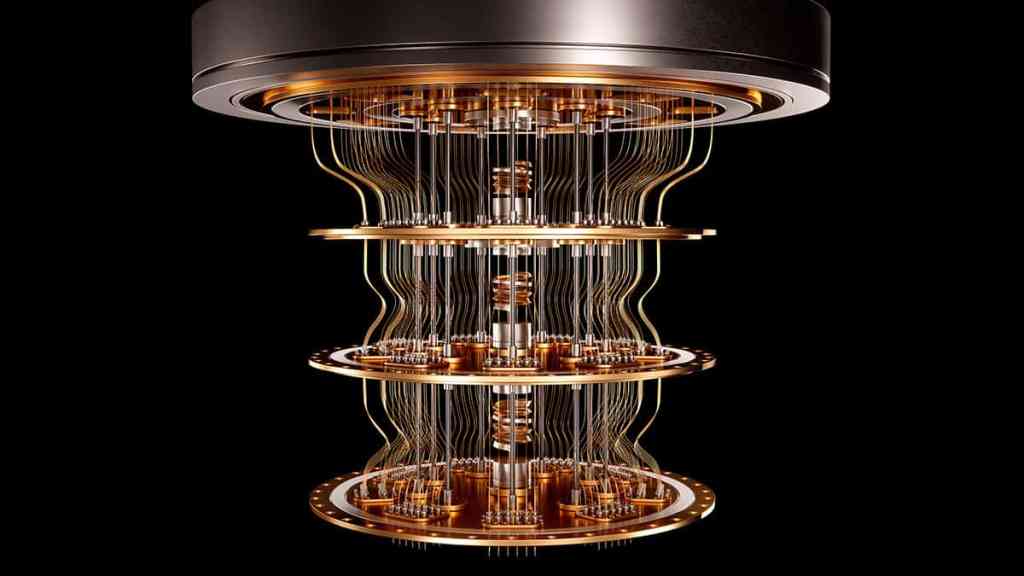
Quantum computers today are like the first digital computers of the 1940s and 50s: they’re the size of a physics laboratory.
Depending on the technology, the qubits may need to be:
• Frozen to temperatures 100x colder than deep space (<20 mK)
• Operated in a vacuum chamber 15 orders of magnitude below atmospheric pressure (~10-9 Pa)
• Aligned on an optical table with a series of mirrors, beamsplitters, optical modulators, lasers, and photon detectors
• Hooked up to racks of electronics including current sources, waveform generators, and microwave signal generators
Today researchers and industry leaders are using the cloud to take advantage of these very big prototypes for “hybrid quantum computing.” We use classical computers to run the majority of our code, including making the call to the quantum computer and saving and processing its output.
It’s very likely that this pattern will continue even when more powerful quantum computers are available. Similar to how we outsource data-heavy processing work to GPUs today, we’ll continue to outsource the part of our algorithms that exhibit a quantum speedup to the quantum computers.
Quantum computers this decade
There remain several significant engineering challenges faced by the developers of quantum computers.
If it were easy to build, we’d have one already!
It’s tough to:
- Find control and readout technologies that maintain qubit coherence even at mK temperatures (around -273 C or -459 F).
- Get some qubits to interact with one another (photons).
- Get some qubits NOT to interact with one another (limiting cross-talk between semiconductor qubits).
- Prepare consistent initial states.
- Build high-fidelity quantum memory.
- Limit background noise. Much of the equipment that makes up a quantum computer is there to isolate the qubits from environmental noise such as heat, mechanical vibrations, and electromagnetic background radiation.
- Ensure long coherence times and fast gate speeds. Qubits with long lifetimes tend to have less interaction with their environment, but as a result are harder to “talk to” and respond more slowly to control fields. There is a tradeoff between coherence times and gate speed.
- Build a 3D integration of qubits and their control mechanisms. Concepts exist for integrated electrical and optical chips, but they remain difficult to produce. Some qubits require elements be within nanometers of each other so manufacturing requires very high precision. The topologies we choose also need to be scalable.
- Detect and correct errors. You can easily measure an error made by a classical bit (such as a voltage drop) and reset it immediately. Unfortunately, measuring the qubit’s state disrupts the state irreversibly – so we have to get creative with strategies for quantum error correction.
- Write quantum algorithms. You must ensure your code solves the problem and encodes the resulting answer in a single state with high probability.
Luckily for us there are dozens of organizations tackling these challenges across a variety of qubit modalities, each with their own strengths and challenges. The hope is that within the decade we will overcome many of these challenges and realize a universal fault-tolerant quantum computer that scales.
 Melissa Valdez, MSc