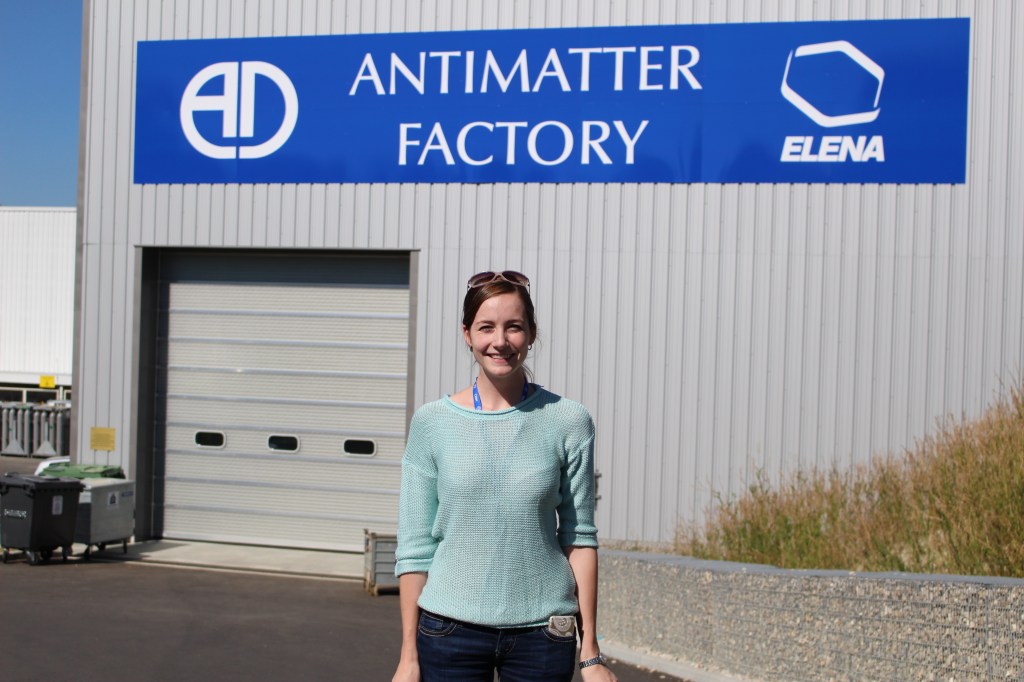
Above: Melissa in front of CERN’s Antiproton Decelerator facility, colloquially the ‘Antimatter Factory’. Several world-class antimatter experiments are housed here.
Graduate Research
I started my graduate studies in September 2015 at York University. My supervisor, Professor Scott Menary, is part of the ALPHA (Antihydrogen Laser PHysics Apparatus) collaboration at CERN, in Geneva, Switzerland. I spent three months living and working at CERN and wrote about some of my experiences on my blog.
I’m so proud to have worked on this experiment, a product of decades of hard work by some of the most driven and passionate physicists I’ve ever met. I’m humbled to be an author on the Nature papers reporting the first observation of the spectrum of light on antihydrogen and subsequently the observation of the hyperfine spectrum of antihydrogen.
For a short summary of my project, read the transcript my Three Minute Thesis below:
Undergraduate Research
As part of my honours year of my Bachelor of Science at the University of Windsor, I wrote a thesis on selectively enhancing the light transmitted through solar cells.
In order to make solar a more competitive and affordable technology, engineers are designing cells with thinner semiconductor layers. This in turn decreases the solar cell’s efficiency. My solution was to enhance the wavelengths of light that are best absorbed by the semiconductor by adding a layer of gold nanoparticles to the solar cell. I ran simulations to determine the optimal size and spacing of gold nanoparticles that would achieve maximum efficiency in silicon solar cells.
At the first annual UWill Discover Research Conference I presented my work and placed first in the science category! A preview of my talk is below:
 Melissa Valdez, MSc